
Garage door panel repair vs replacement is the decision that every Australian homeowner faces when their sectional garage door panel is dented, damaged, or deteriorated. A garage door panel that has been hit by a vehicle, damaged by a falling object, or that has developed corrosion or deformation over years of exposure faces a decision tree:
can the individual panel be repaired or replaced while the rest of the door remains in service, or has the damage to the panel compromised the door sufficiently that full door replacement is the more appropriate outcome? Garage door panel repair vs replacement addresses the specific diagnostic questions that determine which path is correct for a given situation — and in doing so, helps Australian homeowners avoid both the expense of an unnecessary full door replacement and the false economy of repairing a panel on a door that has fundamentally reached the end of its service life.
Understanding what a sectional door panel actually does
Before the garage door panel repair vs replacement decision can be made sensibly, it is worth understanding what each panel in a sectional door system contributes to the door’s function. A sectional garage door consists of four to five horizontal panels connected by hinges. Each panel contributes to:
- Structural integrity — the panels provide the rigidity of the door as a whole. A panel that has been significantly deformed — bent across its width rather than dented at a single point — changes the overall shape of the door and can cause adjacent panels to bind at their hinge connections.
- Weatherseal function — the horizontal joints between panels include a seal that prevents rain, wind, and draught from entering the garage at the panel junctions. A damaged panel whose profile has been altered at the junction point compromises the seal between itself and the adjacent panels.
- Appearance — the panels are the visible face of the door from the street or driveway. A dented or corroded panel is an aesthetic issue that affects the property’s kerb appeal.
- Load path — in foam-insulated double-skin panels, the insulation also contributes to the panel’s structural stiffness. A panel whose outer skin has been compromised may have reduced structural contribution even if the visible deformation appears minor.
When individual panel replacement is the right call
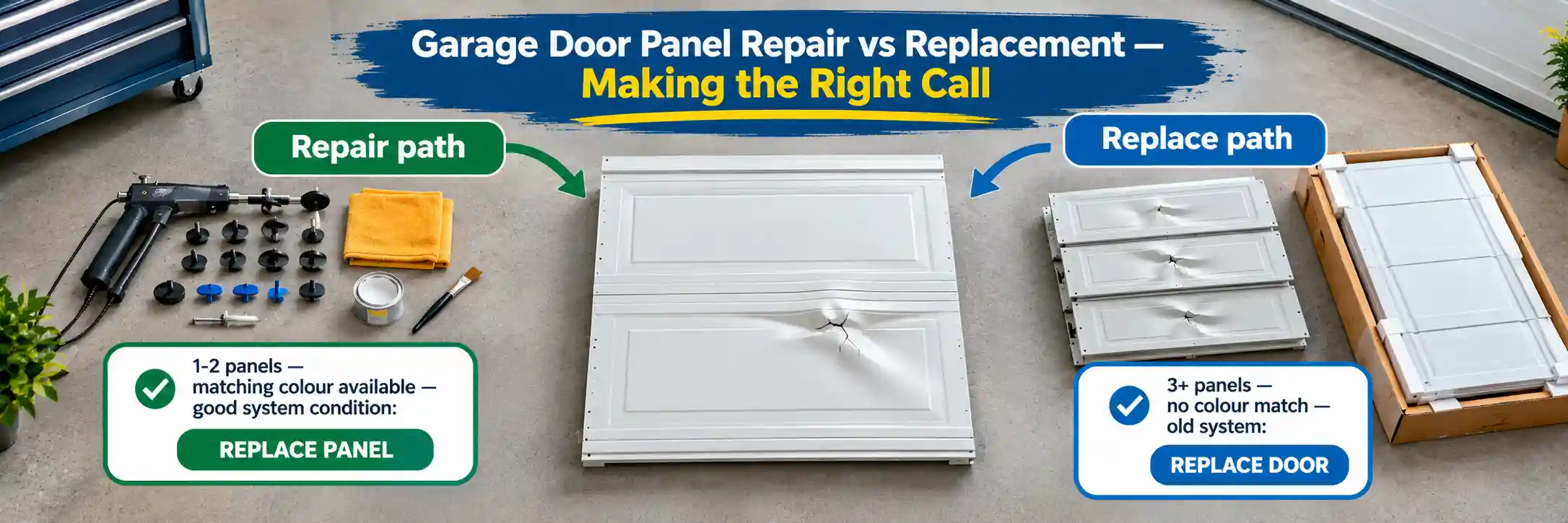
Garage door panel repair vs replacement: individual panel replacement is appropriate when:
- The damage is limited to one or two panels — a sectional door where only one or two of its four to five panels are damaged is a strong candidate for individual panel replacement. The remaining panels are in good condition, the spring system is functional, the track and hardware are serviceable, and the specific damaged panel or panels can be sourced as replacement components.
- A matching panel is available — individual panel replacement for a sectional door requires that a panel matching the existing door’s profile, colour, and dimensions is available. For doors from major Australian manufacturers (B&D, Gliderol, Centurion, ATA) and their common profiles in standard Colorbond colours, panel availability is generally reasonable within the normal product range. For older doors, discontinued profiles, or non-standard colours, matching panel availability may be limited.
- The door is not near the end of its overall service life — replacing a single panel on a door that is 20 years old and whose spring, track hardware, and other panels are all approaching service limits is a decision that warrants consideration of whether the panel replacement investment is justified given the overall system condition. If the door is otherwise in good condition and likely to have significant remaining service life, the panel replacement is sound. If the door is near the end of its life regardless of the panel, a full door replacement may represent better long-term value.
- The hinge connections adjacent to the damaged panel are undamaged — a panel that has been hit with sufficient force to significantly deform its face may have also bent or cracked the hinge brackets at its top and bottom edges. If the adjacent hinge connections are intact and undamaged, the panel replacement is straightforward. If the hinges are damaged, they must be replaced alongside the panel.
When full door replacement is the right call
Garage door panel repair vs replacement: full door replacement becomes the appropriate outcome when:
- The door has three or more damaged panels — replacing three or more panels of a four or five-panel door approaches or exceeds the cost of a full door replacement, without the benefit of starting with a complete, new door whose full system life expectation is reset. At the three-panel threshold, a full door replacement is typically the better value outcome.
- A matching panel is not available — a panel that cannot be matched in profile, colour, or dimension leaves the homeowner with a choice between a mismatched repair that is visually inconsistent, a full repaint of the door to a colour available in the replacement panel, or a full door replacement that produces a consistent result. Where matching panels are not available and visual consistency matters, a full door replacement provides the clean outcome that a mismatched repair cannot.
- The structural damage extends to the frame or track — damage that has bent the horizontal stile bars at the top or bottom of the door, or that has deformed the guide tracks through which the door travels, is structural damage that goes beyond panel replacement. A structurally compromised door frame or track system is a full replacement scenario.
- The door is beyond its effective service life — a sectional door whose spring has been replaced twice, whose rollers are worn, whose track is rusting, and whose overall system condition is tired should not receive individual panel replacement investment. The panel replacement cost is better directed toward a new door that starts with a full-life expectation across all components.
The dented panel — repair or replacement?
Garage door panel repair vs replacement for a dented panel that has not been replaced is a specific sub-question. Minor dents on a sectional door panel — small dents from hail, minor contact damage that has not deformed the panel’s profile or compromised its weatherseal — can sometimes be addressed with panel repair techniques including panel pulling or dent repair. However, the success of dent repair on a steel garage door panel depends on the severity of the dent, the panel profile, and whether the paint coat has cracked at the dent point.
A dent that has cracked the paint coat is a dent whose repair will always be visible — the repaired area will show the paint crack lines even after the dent has been pulled and re-painted. For street-facing garage doors where kerb appeal is a priority, a cracked-paint dent on a standard Colorbond panel is typically better addressed by panel replacement than by dent repair. For rear-facing or internal garage panels where appearance is less critical, a dent repair that restores the panel’s structural profile is an acceptable outcome even with visible paint cracking.
Getting the panel replacement specification right
Garage door panel repair vs replacement, when the decision is panel replacement, requires confirming the following before any panel is ordered: the door manufacturer and product range, the panel profile (flat, ribbed, raised panel, or other), the Colorbond colour code or equivalent colour specification, and the panel dimensions — height, width, and thickness. A panel ordered to incorrect specifications cannot be installed, and most panel suppliers have a non-return policy on custom-ordered panels. A technician’s site measurement of the existing panel before ordering is the step that prevents this situation.
The garage door panel repair vs replacement decision, approached with accurate information about the damage extent, the matching panel availability, the door’s overall condition, and the total investment in each path, produces the right outcome for the specific situation rather than a default to one option.
The homeowner who asks their garage door technician to assess the full door condition alongside the panel damage — not just the panel in isolation — is the homeowner who makes the repair vs replacement decision with all the relevant information on the table. That assessment, provided honestly and in writing, is the service standard that a reliable Australian garage door company delivers as a matter of course, and the information that makes the garage door panel repair vs replacement decision one that the homeowner can make with genuine confidence.
Conclusion
Garage door panel repair vs replacement is decided by the number of panels damaged, the availability of matching replacement panels, the condition of the surrounding door system, and whether the investment in panel replacement is sound given the door’s remaining overall service life. Individual panel replacement is the right call for isolated damage on a door that is otherwise in good condition and whose matching panel is available.
Full door replacement is the right call when the damage is extensive, a matching panel cannot be sourced, or the door has reached the point where its overall system condition makes individual component investment no longer the best use of the homeowner’s maintenance budget.