
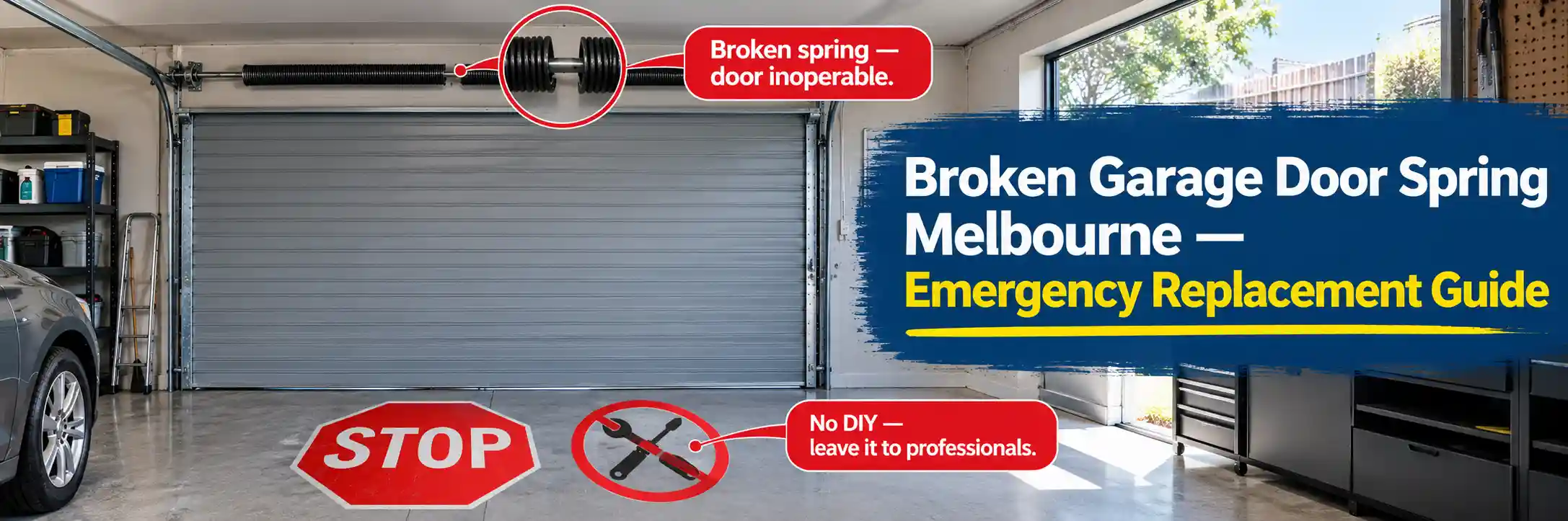
A broken garage door spring in Melbourne is one of the most common garage door emergencies across the city, and it happens without warning in most cases. One moment the door operates normally.
The next, there is a loud crack from the garage — or nothing at all, just a door that will not lift. A broken garage door spring in Melbourne stops the door completely and requires same-day professional attention. This guide covers what the spring does, why it fails, what to do in the first minutes after a Melbourne spring failure, why self-repair is not safe, and how to ensure the replacement spring is specified correctly for the Melbourne home and environment it will serve.
What the spring does in a Melbourne garage door
The spring in a Melbourne garage door system is the component that carries the weight of the door, making it light to operate both manually and automatically. A garage door — whether roller, sectional, or tilt — weighs between 40 and 100 kilograms depending on its size and material. Without a correctly tensioned spring, this full weight must be lifted by either the opener motor or by hand. Neither is designed to do this on an ongoing basis.
In a roller door, the spring sits inside the drum housing above the opening, wound around the shaft. As the door closes and the curtain uncoils from the drum, the spring winds tighter and stores energy. As the door opens, the spring unwinds and releases that energy to lift the curtain. In a sectional door, the torsion spring or springs sit on a horizontal shaft above the door opening and operate on the same principle. In an older tilt door, extension or coil springs on each side of the opening counterbalance the door’s weight through its pivot arc.
The spring operates under constant tension — it is always loaded, even when the door has been stationary for days. This constant tension, combined with the repeated winding and unwinding of every door cycle, means the spring is always working and always accumulating fatigue. When the accumulated fatigue reaches the spring’s structural limit, it snaps.
Why Melbourne garage door springs fail
A broken garage door spring in Melbourne typically fails for one of these reasons:
- Cycle life exhaustion — standard residential springs are rated at 10,000 operating cycles. At two door operations per day, this represents approximately 13 years of theoretical service life. Melbourne family households where the garage is the primary entry point may cycle the door four to six times daily, reaching the 10,000-cycle limit in as little as 4 to 7 years. High-cycle springs rated at 20,000 or 30,000 cycles are the appropriate upgrade for high-use Melbourne households.
- Corrosion from Melbourne’s climate — Melbourne’s variable weather creates moisture exposure conditions that corrode unlubricated springs over time. Bayside Melbourne suburbs — Albert Park, Brighton, Sandringham, Beaumaris — add salt air from Port Phillip Bay that specifically accelerates spring metal corrosion. A spring in a Sunshine garage faces Melbourne’s westerly weather; one in a Brighton garage faces Port Phillip Bay salt air. Both are affected by corrosion if not regularly lubricated.
- Incorrect specification from previous installation — a spring that was not correctly matched to the door’s weight when it was installed operates at the wrong tension level. A spring under more tension than its specification was designed for reaches its fatigue limit faster than the cycle rating implies.
- Lack of maintenance — an unlubricated spring develops surface rust that weakens its effective cross-section at every rust pit. Surface rust on a spring under constant tension accelerates the fatigue cracking that leads to failure.
What a broken spring looks and sounds like in Melbourne
A broken garage door spring in Melbourne typically presents as:
- ● A loud crack or bang from the garage — the spring snapping under full tension releases its stored energy in a fraction of a second, producing a sharp sound that is often heard throughout the home or from outside. Many Melbourne homeowners report thinking something had fallen over in the garage before realising it was the spring.
- ● A door that will not open — the opener motor attempts to raise the door but immediately disconnects via the safety cutout, or the door lifts barely a centimetre before stopping. The door feels extremely heavy when manually tested.
- ● A visible gap in the spring coil — if the spring is visible above the door, a clear separation in the coil confirms the failure.
- ● A door hanging unevenly — on a two-spring system where only one spring has failed, the door may hang at a slight angle because the counterbalancing force is now uneven.
Immediate steps for a Melbourne broken spring
- Stop all operation — do not attempt to run the automatic opener or manually lift the door. Pull the emergency release cord on the opener to disconnect the motor.
- Note the door’s position — open or closed. If the door is stuck open and the garage is connected to the home, the internal access door between the garage and home should be locked while waiting for the technician.
- Call a Melbourne garage door technician for same-day service. Provide the door type (roller, sectional, or tilt), whether the door is open or closed, and whether you can see the spring failure visually.
- Do not attempt to manually lift a door whose spring has failed. The full door weight — potentially 80 to 100 kilograms for a large sectional door — cannot be safely lifted by hand without the spring’s counterbalancing assistance.
Why broken spring replacement is not a DIY job
A broken garage door spring in Melbourne must be replaced by a qualified technician. The spring is wound to a tension that corresponds to the full weight of the door. Releasing this tension without the correct winding bars and the specific procedural knowledge required creates a risk of the spring releasing its energy in an uncontrolled manner.
The winding bars used by professionals are specific tools that engage the winding cone on the spring shaft; using improvised tools in their place is a well-documented cause of serious hand and wrist injuries. The safety risk is not theoretical — it is the reason that spring replacement appears consistently on lists of most dangerous DIY home maintenance tasks in Australian safety publications.
Specifying the right replacement spring for Melbourne
A broken garage door spring in Melbourne should be replaced with a specification that accounts for both the door’s weight and the Melbourne environment:
- High-cycle springs — 20,000 or 30,000-cycle springs are available for most door types and represent a longer service life for Melbourne households with high daily use.
- Corrosion-resistant coating — galvanised or powder-coated springs provide better durability in Melbourne’s variable weather and specifically in bayside suburbs where salt air accelerates bare steel corrosion.
- Both springs replaced simultaneously — for two-spring systems, both springs should be replaced in the same visit. The second spring has the same cycle history as the failed one.
For Melbourne homeowners across the western suburbs — Sunshine, St Albans, Laverton, Hoppers Crossing, and beyond — a garage door spring failure in a car-dependent neighbourhood where the garage is the primary vehicle access point is a specific practical urgency that goes beyond mere inconvenience. A car blocked in a garage in a suburb where everything requires a car is a situation that genuinely disrupts the household’s ability to function for the duration of the repair wait.
The preparation that minimises this disruption — the Melbourne garage door technician’s number saved before the emergency, the door type and access configuration already noted so the call is informative rather than uncertain — is available to every Melbourne homeowner right now, not only after the spring has already snapped. The five minutes spent making this preparation may save several hours of disruption when the spring eventually reaches its failure point.
The annual maintenance visit that follows a spring replacement is the single most effective action a Melbourne homeowner can take to extend the new spring’s service life. Lubrication with a corrosion-resistant product, spring condition inspection, cable and guide assessment, and opener function testing together address all the failure mechanisms that will eventually affect the new spring. A Melbourne garage door company that performs the replacement and offers a follow-on maintenance programme is one that is thinking about the homeowner’s long-term interest rather than the transaction alone.
Conclusion
A broken garage door spring in Melbourne requires immediate stop-use and a same-day call to a qualified Melbourne garage door technician. The spring replacement is not a safe DIY repair regardless of the homeowner’s general mechanical capability. The correct replacement specification — high-cycle, corrosion-resistant, both springs replaced simultaneously — combined with a lubrication programme that extends the new spring’s service life is the approach that produces a reliable long-term outcome for Melbourne’s diverse garage door stock.