
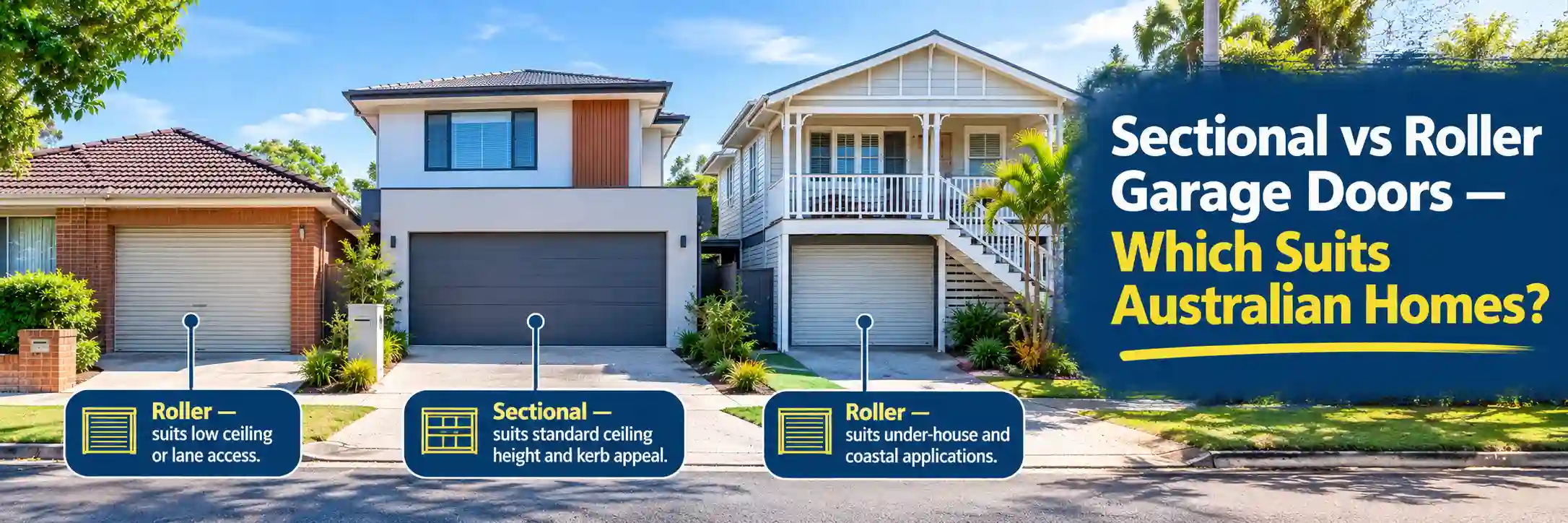
Sectional vs roller garage doors is the most common garage door buying decision for Australian homeowners replacing an older tilt door or choosing a door for a new garage, and it is a decision where the correct answer depends entirely on the specific configuration of the garage rather than a universal preference for one type over the other.
Both sectional and roller doors are widely used across Australian residential properties, both are available with reliable automation systems, and both can be specified in a range of materials and finishes that suit the diverse housing types of Australian suburbs. Sectional vs roller garage doors for Australian homes addresses the specific dimensions, structural requirements, performance characteristics, and use-case suitability of each type to give homeowners the factual foundation for choosing the right door for their specific property.
How sectional garage doors work in Australian homes
A sectional garage door consists of four to five horizontal panels connected by hinges along their horizontal edges. When the door opens, the panels travel upward along vertical tracks at the sides of the opening and then pivot to a horizontal position along tracks that run along the ceiling of the garage. The fully opened door panels are stored horizontally above the garage floor, parallel to the ceiling.
For a sectional door to function correctly in an Australian home, the garage needs to meet two dimensional requirements. The first is headroom: the space above the door opening for the track to transition from vertical to horizontal, typically 300 to 450 millimetres above the opening height depending on the track configuration. The second is ceiling depth: the internal length of the garage from the door opening to the rear wall must accommodate the fully retracted door panels, which occupy the opening height in ceiling depth plus a clearance margin.
Australian garages built from the 1990s onward typically meet these dimensional requirements as a matter of standard design. Older Australian garages — 1960s and 1970s homes in Melbourne’s suburbs, Queensland’s post-war homes, and other established suburban housing — may have lower ceiling heights or shorter internal depths that limit the headroom available for a sectional door’s track configuration.
How roller garage doors work in Australian homes
A roller garage door consists of interlocking steel slats that coil into a drum above the opening as the door is raised. The drum sits inside the garage ceiling or just above the opening, and the curtain travels straight up — parallel to the face of the opening — without swinging out in front of the door or requiring horizontal track along the ceiling.
The roller door’s minimal space requirements make it suitable for Australian garages that cannot accommodate a sectional door’s track configuration. A low-ceiling garage, a garage with limited internal depth, or a back-lane access garage in an inner Melbourne terrace suburb can all accommodate a roller door where a sectional door cannot. The roller door’s vertical travel also means there is no clearance requirement in front of the opening during operation — a vehicle can be parked closer to the door face than with a tilt door, and the lane space in front of the opening is not interrupted by the door’s arc.
The key performance comparison for Australian homeowners
Sectional vs roller garage doors in Australian homes has several performance dimensions worth comparing directly:
- Insulation — sectional doors are available with foam-filled double-skin panels that provide meaningful thermal insulation. This is relevant for Australian homes where the garage is attached to the main living area and the garage temperature affects the adjacent room. Roller doors in standard curtain form are a single skin of steel without insulation; insulated roller doors with foam-backed curtains are available but are less widely specified than insulated sectional panels.
- Security — both types provide comparable residential security when correctly installed. A sectional door with a correct-specification locking system and an automated opener with rolling code technology is as secure as a roller door with equivalent hardware. The key security dimension is the quality of the installation and the hardware specification rather than the door type itself.
- Appearance — sectional doors offer the wider range of visual profiles — flat panel, raised panel, timber-look, aluminium frame with glass — and are available in a broader range of aesthetics suitable for Australian homes from contemporary to heritage. Roller doors in standard curtain form present a uniform slatted face whose visual simplicity is appropriate for functional applications but offers less design variety than sectional panels.
- Maintenance — both types require similar annual maintenance: spring inspection and lubrication, guide component service, opener function testing. Sectional doors have more components — more hinges, more rollers, more track sections — and correspondingly more maintenance points. Roller doors have a simpler mechanism but the curtain slat joints accumulate debris that requires periodic cleaning.
- Noise — roller doors with a tubular motor inside the drum are typically the quietest garage door installation available for Australian residential applications. Sectional doors with a belt-driven motor are also quiet, but the belt-driven motor on a ceiling-mounted drive rail generates slightly more vibration transmission through the ceiling structure than a tubular motor internal to the drum.
Which suits which Australian home type
Sectional vs roller garage doors in Australian homes by property type:
- Inner Melbourne and Sydney terrace homes with lane or narrow driveway access — roller door. The vertical travel with no lane clearance requirement and the minimal headroom configuration are the practical advantages that make roller doors the standard for these applications across Australia’s densely built inner suburbs.
- Suburban Australian family homes with standard garages — either type. The choice is driven by ceiling height confirmation, insulation priority, and aesthetic preference. A standard suburban Australian garage of the 1990s or later typically accommodates both types without constraint.
- Large homes with double or triple garage openings — sectional. Sectional doors scale more reliably to wide openings than roller doors, and the panel-based construction provides the range of profile and material options appropriate for a prominent frontage on a large Australian home.
- Australian coastal homes — roller doors with marine-grade hardware specification have an advantage in coastal environments because the drum-internal motor is better protected from salt air than a ceiling-rail mounted sectional door motor. For bayside Melbourne, Queensland coastal suburbs, and NSW beachside properties, a well-specified roller door is the lower-maintenance coastal option.
The Australian climate dimension
Sectional vs roller garage doors in Australian homes has a climate dimension that varies significantly across the country. In Melbourne’s variable climate with hot summers and cool winters, an insulated sectional panel is a meaningful upgrade for any attached garage. In Brisbane’s subtropical climate where the primary climate management is cooling rather than heating, the insulation dimension is less critical than ventilation.
In coastal areas across Australia, the material specification for corrosion resistance is the primary selection criteria above door type. The correct answer for an Australian homeowner is always contextualised to the specific climate of the specific location.
The sectional vs roller decision for Australian homes is ultimately made correctly by an experienced Australian garage door installer who visits the property, measures the opening and internal dimensions, and confirms which types are technically viable before the selection conversation even begins. A homeowner who has confirmed the dimensional viability of both types for their specific garage is in the best position to then choose between them based on the insulation, aesthetic, and security priorities that matter to their household and property.
An installer who quotes without visiting — assuming standard dimensions that may not apply to an older Australian home — creates the risk of a product order that is technically incompatible with the specific garage it was ordered for. The site visit that precedes the quote is the protection against this outcome and the foundation of a confident sectional vs roller decision.
The ongoing maintenance question for sectional vs roller in Australian homes is manageable for both types. An annual service by a qualified Australian garage door technician covers the equivalent maintenance points for either system: spring inspection and lubrication, track and roller service, opener calibration and safety testing, and weatherseal condition.
The additional hinge and panel joint points in a sectional door add marginally to the maintenance scope, but not in a way that changes the maintenance burden significantly for a well-installed Australian sectional door. Both types, correctly installed and correctly maintained, deliver decades of reliable service in Australian residential applications.
Conclusion
Sectional vs roller garage doors for Australian homes comes down to the specific dimensions of the garage, the climate of the location, the aesthetic priorities of the homeowner, and the daily use pattern of the household. Roller doors suit applications where ceiling height or internal depth is limited, where lane clearance is constrained, or where coastal environment protection is the primary material priority.
Sectional doors suit applications where insulation performance matters, where a wider range of visual profiles is desired, or where a large opening requires the scaling advantages of panel-based construction. A site assessment by an experienced Australian garage door installer confirms which type is technically viable for a specific garage and provides the basis for a confident selection within the viable options.